Who Pays After a Golf Cart Passenger Injury in Florida?
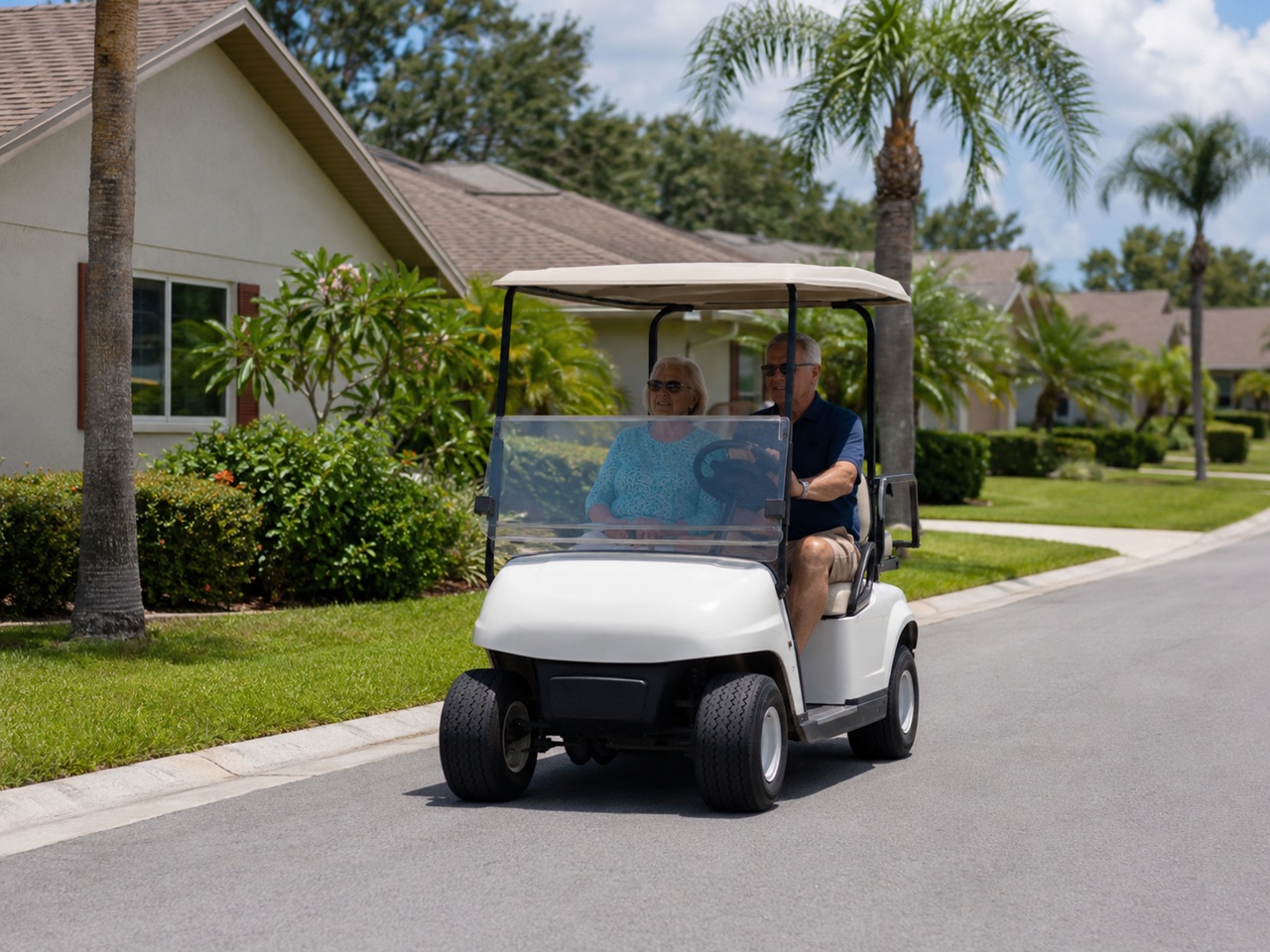
A Passenger May Have Claims Against the Driver, Cart Owner, Another Motorist, or Another Responsible Party
Riding as a passenger in a golf cart can feel routine in Central Florida. In communities such as The Villages, carts are used for far more than a round of golf. Residents use them to visit restaurants, shops, recreation centers, and neighbors.
But a Florida golf cart accident can leave a passenger with serious injuries and an unexpectedly complicated insurance problem.
A conventional golf cart doesn't necessarily carry the same insurance required for an ordinary passenger car. Some carts are legally classified as low-speed vehicles and follow different registration, equipment, and insurance rules. The driver may not own the cart. A resort, golf course, rental business, homeowner, or community may be involved. Sometimes a car or truck caused the collision.
For an injured passenger, determining who pays usually starts with determining exactly what happened, who owned and controlled the cart, what type of vehicle it was legally, and which insurance policies may apply.
Our Central Florida passenger injury attorneys investigate those issues rather than assuming that one driver's insurance is the only possible source of compensation.
Is It Legally a Golf Cart or a Low-Speed Vehicle?
This distinction matters more than many people realize.
Under Florida Statute § 320.01, a golf cart is a vehicle designed and manufactured for use on a golf course for sporting or recreational purposes that isn't capable of exceeding 20 miles per hour.
A low-speed vehicle, commonly called an LSV, is a four-wheeled vehicle capable of traveling faster than 20 miles per hour but not faster than 25 miles per hour.
| Issue | Golf Cart | Low-Speed Vehicle |
|---|---|---|
| Maximum Speed | Not capable of exceeding 20 mph. | More than 20 mph but not more than 25 mph. |
| Registration | Generally exempt when lawfully operated under Florida's golf-cart statutes. | Must be titled and registered. |
| Seat Belts | Not included in Florida's statewide minimum equipment requirements, although local rules can be more restrictive. | Required. |
| Insurance | Not subject to the same statewide mandatory auto-insurance scheme as a registered LSV. | Must be registered and insured under Florida law. |
Under § 316.2122, an LSV must have headlamps, stop lamps, turn signals, taillamps, reflectors, parking brakes, mirrors, a windshield, seat belts, and a vehicle identification number. It must also be registered and insured.
A conventional golf cart operated under § 316.212 has a different statewide equipment requirement. It must have efficient brakes, reliable steering, safe tires, a rearview mirror, and red reflectorized front and rear warning devices. Additional equipment is required for authorized nighttime use.
Local governments can also impose additional golf-cart rules in circumstances permitted by Florida law. And § 316.2125 addresses operations within self-contained retirement communities separately.
That is why simply calling the vehicle a "golf cart" doesn't necessarily settle the legal or insurance analysis.
Golf Cart Passengers Can Suffer Serious Injuries Even at Low Speeds
Golf carts may travel more slowly than passenger cars, but their open design can expose occupants to ejection, falls, and direct impact.
A 2024 multicenter study published in Trauma Surgery & Acute Care Open examined golf-cart and ATV injuries treated at 10 Florida pediatric trauma centers from 2016 through mid-2021.
The research involved children under 16, so its results shouldn't be generalized to all adult golf-cart passengers. Within that pediatric population, however, researchers found that golf-cart injuries had a similar overall injury burden to ATV injuries. Children injured in golf-cart incidents also had a higher rate of intracranial injuries, and ejection was common among the cases where ejection status was documented.
Those findings illustrate why the absence of highway speeds doesn't necessarily mean the absence of serious injury.
Can the Golf Cart Driver Be Responsible for a Passenger's Injuries?
Yes, if the driver's negligence caused the accident.
A golf cart operator is expected to use reasonable care under the circumstances. Depending on the evidence, negligence could involve:
- Driving too fast for conditions: Even when a cart remains within its mechanical speed limit, a sharp turn or excessive speed in a curve can increase the risk of ejection or rollover.
- Distracted driving: Looking at a phone, talking to other passengers, or failing to watch the path can contribute to a collision.
- Impaired operation: Alcohol or drugs can affect judgment and reaction time regardless of how slowly the vehicle travels.
- Failure to yield: A driver may cause a crash by entering a roadway or intersection when another vehicle has the right-of-way.
- Unsafe maneuvering: Abrupt steering, careless backing, or operating a cart in a manner inconsistent with the conditions can cause passengers to fall or be ejected.
- Overloading the cart: Carrying passengers outside designated seating or beyond the cart's intended configuration can create additional safety issues.
The fact that a passenger voluntarily got into the cart doesn't excuse negligent driving.
Can the Golf Cart Owner Be Responsible if Someone Else Was Driving?
Potentially, yes.
Florida has an unusually broad common-law rule known as the dangerous instrumentality doctrine.
In Meister v. Fisher, the Florida Supreme Court held that golf carts fall within that doctrine. The court explained that the owner of a golf cart can be held vicariously responsible when the owner entrusts the cart to someone whose negligent operation causes injury.
Permission matters. The doctrine isn't simply a rule that an owner is automatically responsible for everything that happens involving the cart, regardless of how it came to be used.
It is also important not to confuse dangerous-instrumentality liability with negligent entrustment.
Dangerous instrumentality liability can arise from ownership and consensual entrustment even when the owner wasn't personally careless in choosing the driver.
Negligent entrustment is a separate claim based on the owner's own conduct. It may be relevant when, for example, an owner gives the cart to someone the owner knew or reasonably should have known wasn't capable of operating it safely.
What if a Car or Truck Hit the Golf Cart?
Then the motorist who caused the collision may be another potential defendant.
Golf carts and cars frequently interact at crossings and on streets where cart traffic is permitted. If a motorist runs a stop sign, turns into the cart, drives distracted, or otherwise causes the collision, an injured passenger may have a negligence claim against that driver.
Whether an automobile insurer will pay the claim depends on the driver's policy and the applicable coverage. Florida doesn't require every private driver to maintain bodily injury liability coverage in every circumstance, so the existence and limits of bodily injury insurance need to be confirmed rather than assumed.
When a golf cart collision also involves an automobile, the rules governing a Florida motor vehicle accident can become part of the analysis alongside the laws specific to golf carts.
Can the Golf Cart Owner's Insurance Cover the Accident?
Possibly, but there isn't one universal golf-cart insurance policy that applies to every accident.
A conventional golf cart generally isn't subject to the same mandatory registration and PIP requirements as an ordinary automobile or registered LSV. That doesn't mean there is never insurance coverage.
Potential coverage can depend on:
- A policy written specifically for the golf cart or recreational vehicle;
- A homeowners policy;
- An umbrella policy;
- An automobile policy containing language broad enough to cover the particular golf-cart use;
- A commercial policy when a business owns or operates the cart;
- A rental or resort policy; or
- Another policy covering the negligent operator.
The exact policy language matters.
For example, in a 2022 federal appellate decision applying Florida law, GEICO General Insurance Co. v. Gonzalez, a court considered whether an automobile liability policy's definition of a "private passenger auto" included a golf cart being driven by an insured family member. The decision turned on how the policy itself defined the covered vehicle.
That is a useful reminder that insurance coverage shouldn't be accepted or rejected solely on the basis of the word "golf cart."
Does Florida PIP Pay a Golf Cart Passenger's Medical Bills?
Not necessarily.
Florida's Motor Vehicle No-Fault Law defines a covered "motor vehicle" as a self-propelled vehicle with four or more wheels that is of a type both designed and required to be licensed for highway use.
A conventional golf cart is generally exempt from registration when lawfully operated under Florida's golf-cart statutes. Florida courts have therefore distinguished ordinary golf carts from vehicles subject to the standard no-fault insurance system.
A registered LSV is different. Florida requires an LSV to be registered and insured, and the required coverage includes the insurance associated with registration.
There can also be questions about whether another automobile policy, a medical-payments provision, a health insurance policy, Medicare coverage, or another source initially pays treatment costs after the crash.
So an injured passenger shouldn't assume either that PIP definitely applies or that there is no coverage merely because the cart itself didn't carry an ordinary automobile policy.
Could a Property Owner or Community Be Responsible?
Sometimes, but an injury occurring on a community or golf course property doesn't automatically make the property owner or the homeowners association liable.
A premises liability claim can depend on who owned or controlled the area, what duty that party owed, what condition caused the accident, whether the condition was dangerous, and what the responsible party knew or reasonably should have known.
Potential issues could include:
- A large pothole or serious path defect;
- An obscured intersection or crossing;
- Dangerous roadway or cart-path design;
- Missing or inadequate warnings;
- Vegetation obstructing visibility; or
- A maintenance condition that contributed to the cart losing control.
Responsibility for roads, paths, and crossings can also differ between private communities and governmental entities. The location of the accident therefore matters.
Golf-cart use is particularly common in The Villages, where carts use an extensive network of roads, paths, tunnels, and crossings. An investigation there may need to identify who controlled the precise location where the accident occurred rather than assuming one organization was responsible for every part of the transportation network.
What if Something Was Wrong With the Golf Cart?
A mechanical or design problem can create a different type of case.
If defective brakes, steering, tires, seating, or another component caused or worsened the accident, potential claims against a manufacturer, seller, repair business, or another responsible company may need to be investigated.
Product cases require proof of more than the fact that something broke.
The evidence may need to establish what failed, whether there was a design or manufacturing defect, whether warnings were adequate when relevant, and whether that defect actually caused or enhanced the passenger's injuries.
The cart itself can therefore become important evidence. Repairing, modifying, selling, or disposing of it before the cause of the accident has been investigated can make a product-defect claim much harder to prove.
Can a Rental Company or Golf Course Be Responsible?
Potentially.
A rental company, resort, golf course, or other commercial owner may face liability based on its own conduct, depending on the facts.
Examples could include negligent maintenance, providing a defective cart, ignoring a known safety issue, or negligently entrusting a cart to someone who wasn't reasonably capable of operating it safely.
Insurance is a separate question. A rental agreement doesn't automatically guarantee that a particular liability policy will compensate an injured passenger. The contract and applicable insurance policies need to be reviewed.
Can a Passenger Be Found Partly at Fault?
Yes, but simply riding in the cart isn't negligence.
Florida uses modified comparative fault in most negligence cases. Under Florida Statute § 768.81, fault attributable to an injured person generally reduces that person's economic and non-economic damages in proportion to their percentage of responsibility.
For negligence actions subject to the statute, a claimant who is found more than 50% responsible for their own harm generally can't recover damages.
In a passenger case, the defense might argue that the passenger's own conduct contributed to the crash or the resulting injuries. Depending on the evidence, allegations could include standing while the cart was moving, sitting in a location not designed for passengers, interfering with the driver's operation, or other unsafe conduct.
Those allegations still need evidence.
An insurer can't simply assign fault to a passenger because that person agreed to ride in the cart.
What Compensation May Be Available?
The damages available after a golf-cart passenger injury depend on what losses were caused by the accident and what can be proven.
They may include:
- Medical expenses: Emergency care, hospitalization, surgery, medication, rehabilitation, and other reasonable accident-related treatment.
- Future medical care: Additional treatment that medical evidence shows will probably be necessary because of the injuries.
- Lost income: Wages or other earnings lost while the injured person couldn't work.
- Reduced earning capacity: Future losses when lasting limitations interfere with the person's ability to earn income.
- Pain and suffering: Compensation for qualifying physical pain and other non-economic consequences of the injuries.
- Scarring or disfigurement: Lasting visible injuries can become part of the damages analysis.
- Permanent impairment: Serious injuries can affect mobility, independence, and daily activities long after the initial treatment ends.
- Damaged personal property: Phones, mobility aids, or other belongings damaged in the incident may also be part of the claim.
When a passenger suffers a serious or permanent injury, future medical needs and loss of earning capacity can become especially important. Those losses should be supported by medical, employment, and other appropriate evidence rather than estimated solely from the initial hospital bill.
How Long Do You Have to File a Florida Golf Cart Injury Lawsuit?
The deadline depends in part on the legal theory involved.
Under the current version of Florida Statute § 95.11, an action founded on negligence generally must be filed within two years.
But not every golf-cart case is solely a negligence case. Florida provides a different limitations period for certain actions involving the design, manufacture, distribution, or sale of personal property. Claims involving governmental entities can also create additional procedural requirements.
That makes it important to identify the responsible parties and legal theories early, rather than assuming a single deadline governs every possible golf-cart claim.
Evidence Can Help Identify Who Should Pay
When multiple people or businesses may be involved, evidence from the scene can help separate one theory from another.
Useful evidence may include:
- Photos of the cart and where each passenger was seated;
- Photos or video of the path, road, intersection, or hazard;
- The golf cart's make, model, serial number, and owner;
- Witness names and contact information;
- Surveillance or doorbell-camera footage;
- Police or incident reports;
- Rental agreements;
- Maintenance and repair records;
- Insurance policies;
- Medical records documenting the injuries; and
- The golf cart itself when a mechanical defect may be involved.
Preserving the cart can be particularly important when there is a question about brakes, steering, tires, modifications, or other mechanical conditions.
Our Central Florida Lawyers Investigate Every Potential Source of Responsibility
A golf-cart passenger injury can involve much more than a claim against the person sitting behind the wheel.
At Law Offices of Brent C. Miller, P.A., we can investigate the driver, owner, vehicle classification, insurance policies, roadway or property conditions, and the cart itself to determine which claims are supported by the evidence.
Brent C. Miller has practiced personal injury law since 1987 and has handled thousands of personal injury claims. Our attorneys represent injured people throughout Tavares, The Villages, Inverness, Clermont, and surrounding Central Florida communities.
Our published verdicts and settlements include a $150,000 recovery in a golf cart defect case.
If you were injured while riding as a passenger in a golf cart, contact us for a free case evaluation. We can review how the accident occurred, identify the people and companies potentially responsible, and examine the insurance coverage that may apply.
We handle personal injury cases on a contingency-fee basis. There are no upfront attorney fees, and attorney fees are contingent on recovery under the terms of the written fee agreement.
"Mr. Miller is a highly skilled attorney. Should you find yourself in a position that a personal injury attorney is required, I recommend his services. His attention to detail is top-notch, as is his knowledge and experience." - Gina J., ⭐⭐⭐⭐⭐